
Plentitude Art Market
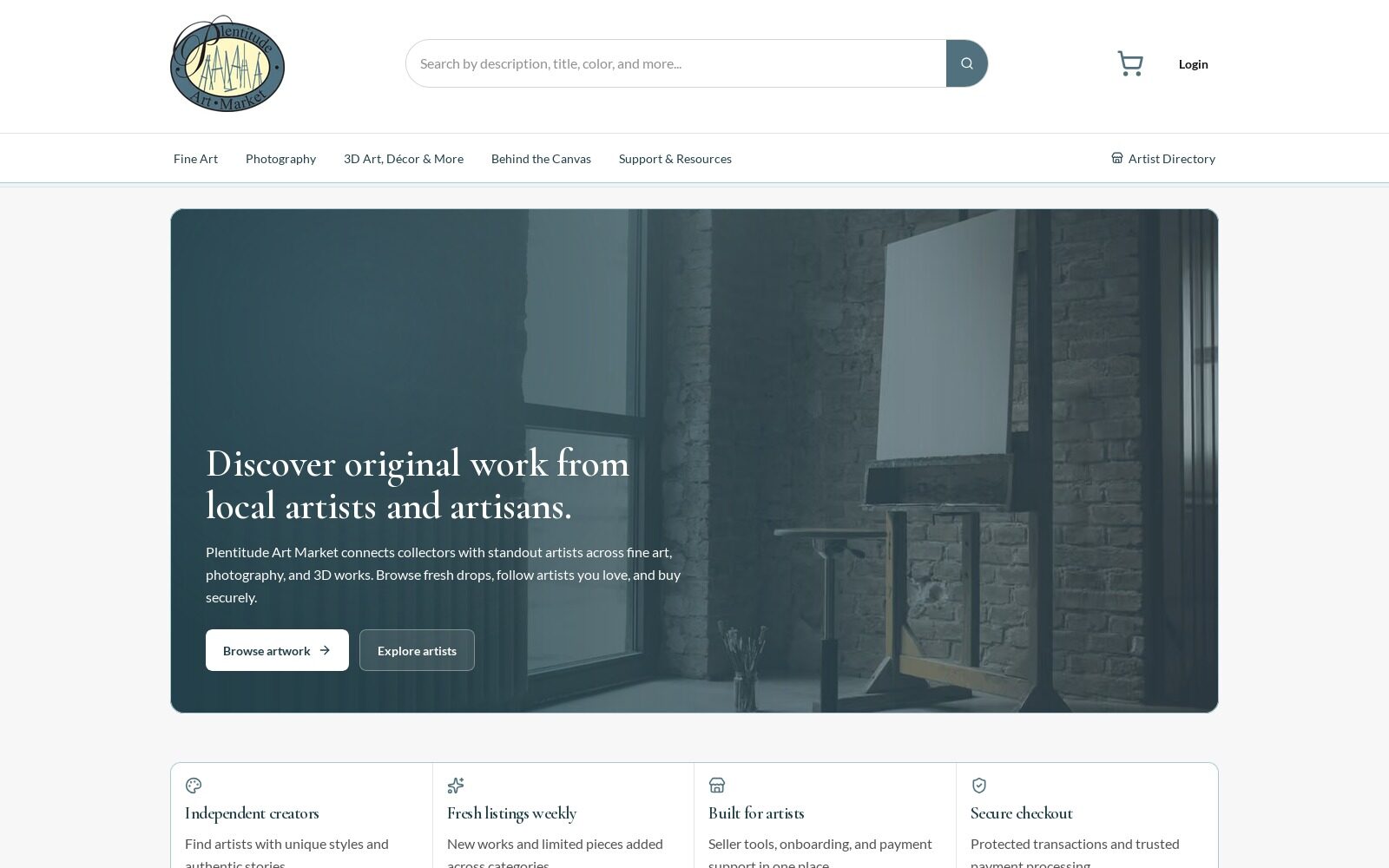
A local art marketplace had outgrown an off-the-shelf store. We are building it a custom marketplace with real artist accounts, direct payouts, and a catalog that can carry thousands of one-of-a-kind pieces.
At a glance
What the engagement covered, and where the work is live.
- Client type
- Online marketplace for independent artists
- Services delivered
- Custom Application Development, Website Design and Development, Hosting and Care
- Timeline
- Multi-phase build, launching shortly
- Live site
- plentitudeartmarket.com
The problem
Plentitude connects collectors with independent artists and artisans, which is a two-sided marketplace wearing the clothes of a shop. An off-the-shelf store handles one seller with many products. It does not handle many sellers, each with their own account, their own listings, their own payouts, and their own one-of-a-kind inventory where every item is a quantity of one.
The approach
We are rebuilding it as a custom application rather than stretching a store plugin further than it goes. A React front end on Next.js talks to an API backend that owns artists, listings, orders and payouts. Artists onboard themselves, list their own work, and are paid directly through Stripe Connect rather than waiting on a manual transfer from the middle.
The outcome
The new build is in staging and rolling out shortly. When it lands, Plentitude gets a marketplace that can add artists without adding administration, a catalog built for originals rather than stock items, and a foundation that can carry features an off-the-shelf store was never going to support.
In detail
What the build actually involved.
Why a store was the wrong shape
A shop platform assumes one seller. Plentitude is the opposite: the value is the artists, and every one of them needs an account, a profile, a place to list work, and money arriving in their own bank without somebody at Plentitude moving it by hand.
Stretched far enough, a store plugin can be made to fake most of that. What it cannot fake is the model underneath. Once the business depends on sellers being able to onboard themselves and be paid automatically, you are not running a shop with extra plugins. You are running a marketplace, and it should be built as one.
There is a second problem that is specific to art. Almost every listing is a quantity of one. Original work sells once. A catalog designed around restockable inventory gets this wrong in small ways constantly, and each of those small ways is a support conversation.
What we are building
A custom marketplace on Next.js, with a React front end and an API backend that owns the domain: artists, listings, orders, payouts.
Self-service artist onboarding. An artist signs up, sets up their payout account, and lists their work without anybody at Plentitude touching a form. This is the difference between a marketplace that can grow and one that grows only as fast as its administrator.
Direct payouts through Stripe Connect, so money reaches the artist rather than passing through an inbox and a spreadsheet.
A catalog built for originals. Fine art, photography, and three-dimensional work, with search that works the way people actually look for art, by description, title, and color, not just by an exact title they do not know.
An artist directory, because on a marketplace the sellers are the product. Collectors follow artists, not categories.
The unglamorous supporting cast. Terms, privacy, a cookie notice, and a takedown process. A platform hosting other people’s creative work needs those to be real from day one, not added after the first complaint.
Where it stands
The build is running in a staging environment with payments in test mode while artists onboard and the catalog is populated, and it is rolling out shortly. The current storefront stays live until it does, which is the right order to do this in: nothing gets switched off before its replacement is proven.
What this one shows
Most of our work is websites. This is the other thing we do, and it is the honest use of a custom build: not a brochure with extra pages, but software that the business actually runs on, scoped and priced as software.
If your idea genuinely needs accounts, payouts, or a data model that a shop plugin cannot hold, that is a different project from a website, and it should be described that way before anyone quotes it.
Tell us what you need built.
No pitch deck and no discovery fee. Most engagements start with a single site, and we add the rest only when it earns its place.
- Send a short brief, or just a link to the site you have now.
- We reply within two business days with questions, or a time to talk.
- You get scope, sequence and a price range in writing before anything starts.